
What can computational cytopathology tell us about treatment outcomes of CML?
Bone marrow (BM) cytomorphology is routinely assessed in hematological malignancies. However, systematic and extensive quantification of morphological features from BM aspirate slides remains a laborious task for humans, limiting what we can learn from them. Cellbytes solves this by transforming digitized BM aspirate slides into a rich cytomorphological dataset, enabling researchers to investigate whether cytomorphological fingerprints are associated with clinical outcomes.
Two recent studies from a multi-site academic collaboration, built on the Cellbytes platform, illustrate this approach in chronic myeloid leukemia (CML).
Can morphology provide information about treatment response in CML?
Treatment response is a central objective in the management of CML. Achieving a sustained deep molecular response (DMR) increases the likelihood of treatment-free remission (TFR), allowing eligible patients to discontinue lifelong therapy.
In a 2026 study published in HemaSphere1, involving 598 patients from seven clinical sites, cytomorphological features were examined for their association with achievement of major molecular response (MMR) in tyrosine kinase inhibitor (TKI)-treated CML patients. Erythroid precursor enrichment, monocyte nuclear lobulation, and low peripheral leukocyte count were found to be associated with increased achievement of MMR. The monocyte finding in particular may point to a link between monocyte maturation and TKI efficacy. When combined with clinical information, these features formed a Morphoclinical model that outperformed the clinically used EUTOS long-term survival score at predicting MMR (AUROC 0.76 vs. 0.53).
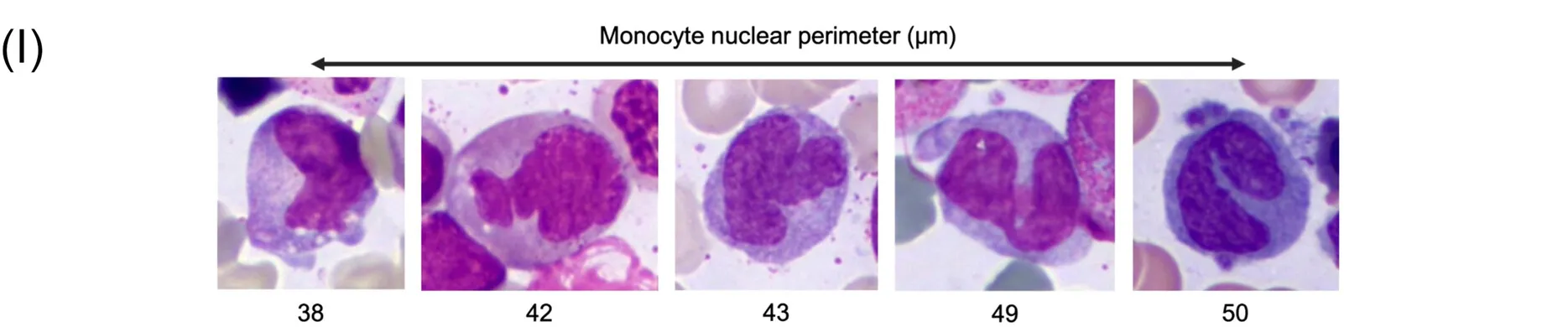
Can morphology help predict treatment-free remission?
For chronic-phase (CP) CML patients who achieve DMR, treatment discontinuation can become an option. Discontinuation trials have shown that around half of patients remain in molecular remission five years after stopping treatment, consolidating TFR as a key goal of therapy. Several biomarkers have been proposed to predict TFR, but none is yet standardized for clinical use.
In a 2025 study published in Leukemia2, involving 113 CP-CML patients from seven clinical sites, BM morphology was examined for its association with TFR success. Neutrophil abundance and granulocytic maturation at diagnosis were found to be associated with sustained TFR: patients who remained in remission tended to show more mature, hypersegmented neutrophils at diagnosis, while relapsing patients had more immature granulocyte forms, such as promyelocytes and metamyelocytes.
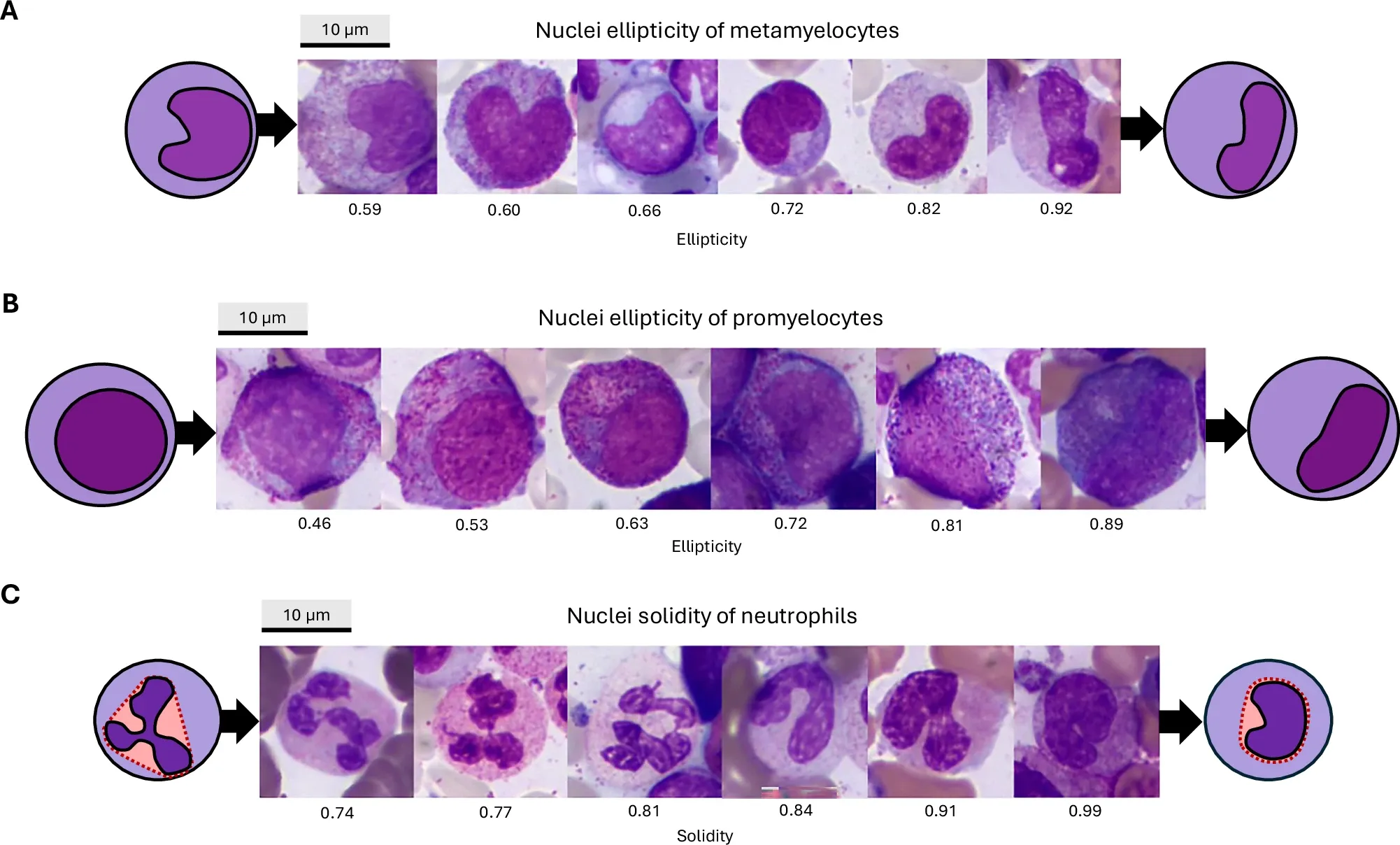
Together, these findings show that computational BM cytopathology can move beyond automated cell counting to reveal biologically and clinically relevant morphological patterns. Both remain research findings that will need further validation before informing clinical decisions.
These two studies are one example of what the Cellbytes platform can support in research settings.
Footnotes
-
Luukkainen, K. et al. Deep cytomorphology identifies erythroid skewing and monocytic morphology to predict TKI sensitivity in CML patients. HemaSphere 10, e70319 (2026). https://doi.org/10.1002/hem3.70319 ↩ ↩2
-
Purhonen, M. et al. Granulocyte abundance and maturation state at diagnosis predicts treatment-free remission in CML. Leukemia 39, 2968–2977 (2025). https://doi.org/10.1038/s41375-025-02769-2 ↩ ↩2